Of Course or Ofcourse: Which One Should You Use?? (Correct Grammar Explained)
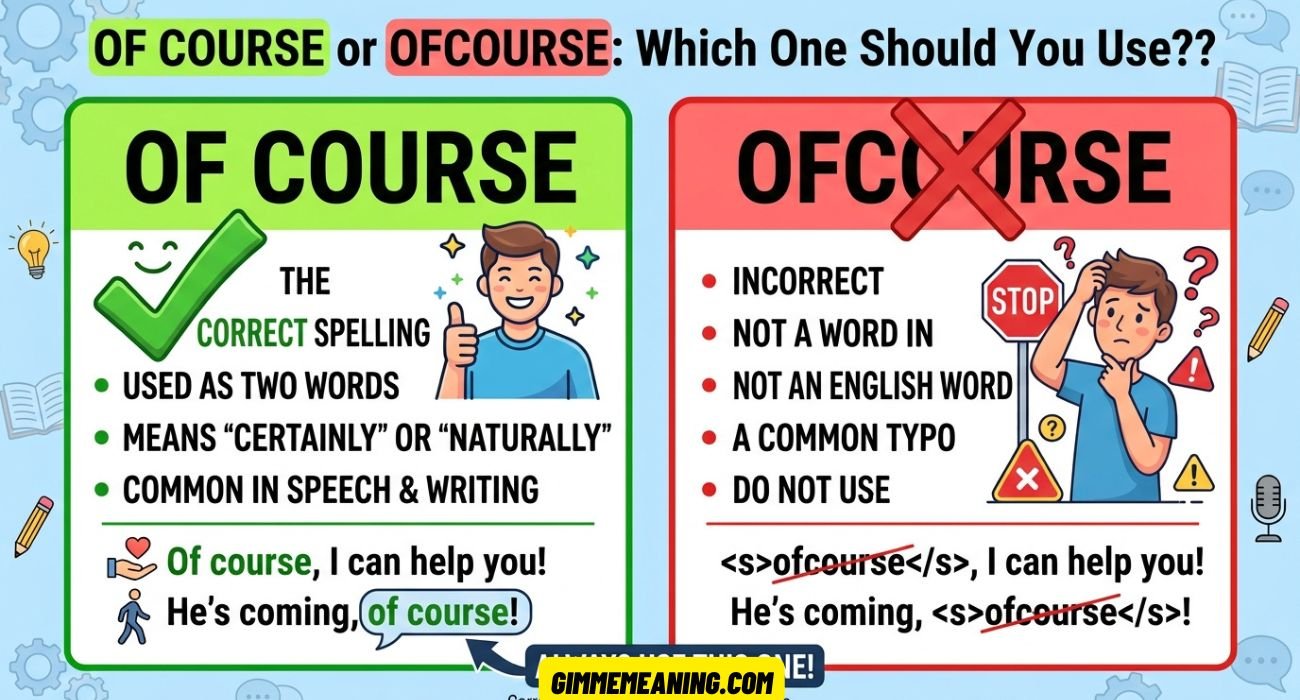
“Of Course or Ofcourse” is a common spelling question in English. The correct form is “of course” with two words. The word “ofcourse” is not correct in standard English. This rule helps improve clear and correct writing.
Many people feel confused when they see both forms online. Social media and fast typing make “ofcourse” look normal. This can trick learners and even native speakers. Knowing the right form will help you write better.
“Of course” is a useful phrase in daily communication. It shows agreement, certainty, and polite response. You can use it in school, emails, and conversations. Learning its correct use will make your English stronger.
Of Course or Ofcourse – Which One Is Actually Correct?
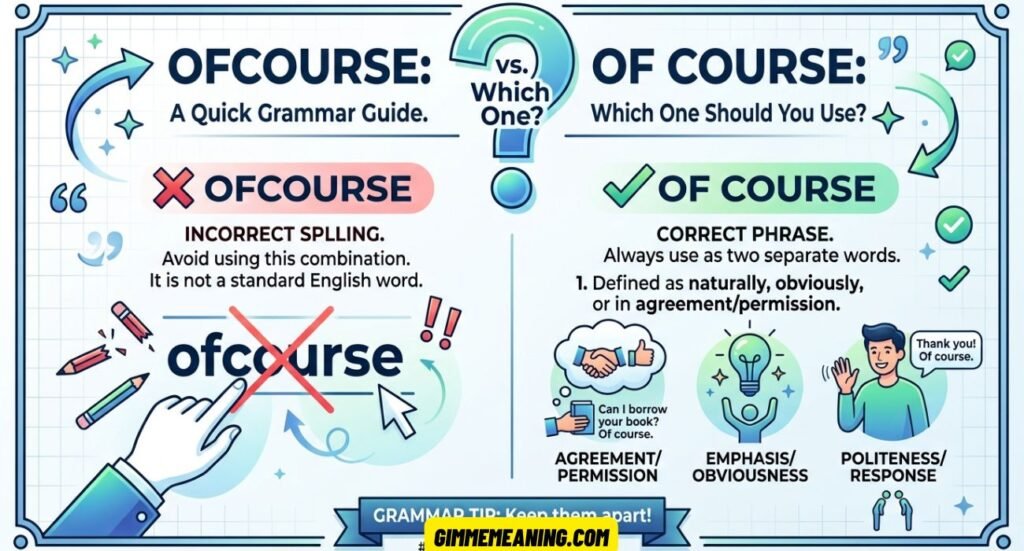
Let’s answer the main question clearly: “Of course” is correct, and “ofcourse” is incorrect.
There is no recognized word “ofcourse” in standard dictionaries. According to widely accepted English grammar rules, “of course” is a two-word phrase. Using “ofcourse” in writing is considered a spelling mistake and can affect your correct word usage and professionalism.
In the United States, correct spelling is especially important in schools, workplaces, and business communication language. Even a small mistake like this can reduce the quality of your message.
Why “Ofcourse” Seems Right — But Isn’t
The confusion around of course vs ofcourse happens because of how we speak and type. When we say “of course” quickly, it sounds like one word. This leads many people to write it incorrectly.
Another reason is the influence of texting and informal communication. People often shorten words and ignore grammar while chatting. Over time, this creates habits that lead to grammar mistakes examples like “ofcourse.”
It also looks similar to other words like everyday vs every day, maybe vs may be, alright vs all right, and atleast vs at least, which are also commonly confused. However, unlike some evolving words, “ofcourse” is still not accepted in standard English.
What Does ‘Of Course’ Really Mean?
The of course meaning is simple but powerful. It is used to show agreement, certainty, or something that is obvious. It is one of the most common natural English phrases used in daily communication.
In grammar, “of course” is known as a discourse marker. It helps guide the tone of a sentence and makes communication smoother. It is often used in expressing agreement in English and in showing certainty in sentences.
Here’s what it means in plain English:
The phrase “of course” can mean “certainly,” “naturally,” “without a doubt,” or “obviously.” It is also used as one of the most common polite expressions in English and polite ways to say yes.
Examples:
Here are some simple of course examples sentences to help you understand how to use of course in real life:
| Context | Sentence | Meaning |
| Casual | Of course I will help you. | Yes, definitely |
| Professional | Of course, we appreciate your feedback. | Polite agreement |
| Academic | Of course, more research is needed. | Neutral statement |
| Friendly | Of course you can come with us. | Warm permission |
These examples show how “of course” works in everyday English usage and formal settings.
Where Did ‘Of Course’ Come From? (Origin & Etymology)
The phrase “of course” has been used in English since the 18th century. It comes from older meanings of the word “course,” which referred to a natural path or direction.
Originally, saying something is “of course” meant it follows the natural order of things. Over time, it became a common way to express certainty and agreement in modern English phrases.
Understanding this origin helps explain why the phrase must stay as two words and why it fits into standard of course grammar.
Is ‘Of Course’ Formal or Informal?
Many learners ask: is of course formal or informal? The answer depends on context and tone.
| Context | Usage | Tone |
| Academic writing | Used carefully | Neutral |
| Workplace emails | Common | Polite |
| Casual conversation | Very common | Friendly |
| Sarcasm | Sometimes used | Negative tone |
In formal vs informal English, “of course” is flexible. It works in both professional and casual situations, which makes it a valuable part of academic writing phrases and conversational English expressions.
How to Use ‘Of Course’ in Sentences
Understanding how to use of course correctly will improve your writing and speaking skills. The phrase can appear at the beginning, middle, or end of a sentence.
In the beginning, it adds emphasis and friendliness. In the middle, it provides additional clarity. At the end, it reinforces agreement.
For example, in of course in a sentence, you might write: “Of course, I agree with your idea.” You can also say, “I will, of course, attend the meeting,” or “Yes, of course.”
These patterns are useful in professional email writing tips and daily communication.
Grammar Tips: Using ‘Of Course’ Correctly
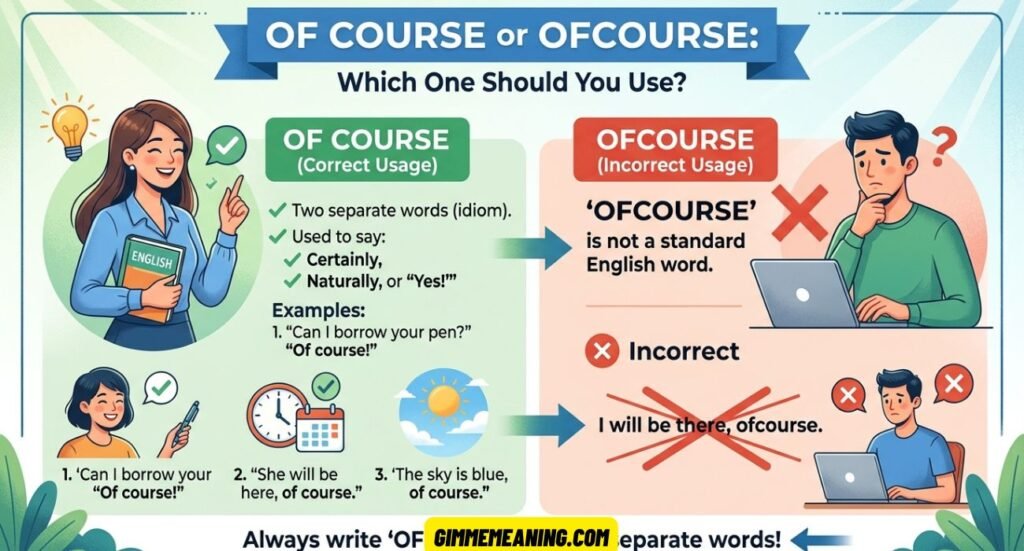
To follow proper of course grammar, remember that it is always written as two separate words. This is one of the simplest but most important English grammar rules.
When used in the middle of a sentence, commas are often needed for clarity. Overusing it should also be avoided, as it can reduce impact and sound repetitive.
Using correct grammar improves writing accuracy and helps you avoid common spelling mistakes in English.
Why Do People Write ‘Ofcourse’?
The mistake “ofcourse” happens for several reasons. It is not about lack of intelligence but about habits and exposure.
Main reasons:
People often type quickly and do not proofread. Mobile keyboards and social media platforms encourage shortcuts. Many learners also assume it is a compound word because of similar patterns in English.
Real Data:
Recent language tools have shown that “ofcourse” is flagged thousands of times every week in U.S. writing. This highlights how widespread this mistake is, even in professional environments.
See Also : “Envolved” or “Involved” – Which Is Correct?
‘Of Course’ vs. Other Similar Phrases
There are many synonyms for of course that can be used depending on tone and context.
| Phrase | Meaning in English | Formality |
| Certainly | Strong agreement | Formal |
| Naturally | Expected outcome | Neutral |
| Sure | Casual agreement | Informal |
| Without a doubt | Strong certainty | Neutral |
Understanding these alternatives helps improve your vocabulary and makes your writing more engaging. It also supports better correct word usage.
Using ‘Of Course’ for Sarcasm or Humor
Sometimes “of course” is used sarcastically. In these cases, the meaning changes completely depending on tone.
Examples of sarcasm:
A sentence like “Of course you forgot again” does not show agreement. Instead, it expresses frustration or irony. In business communication language, using sarcasm can be risky because it may be misunderstood.
‘Of Course’ in Pop Culture and Media
The phrase “of course” appears frequently in movies, books, and social media, especially in the United States.
Famous Quotes:
A well-known example is from Star Wars: “Of course I know him. He’s me.” This shows how the phrase is used to express certainty.
In Books:
In classic literature, authors often use “of course” to reflect social expectations and natural outcomes.
Social Media:
In modern platforms, it is used in memes and jokes. This reflects its role in conversational English expressions and modern everyday English usage.
How to Remember ‘Of Course’ Is Two Words
Many learners struggle to remember the correct form, but there are simple ways to avoid mistakes.
Here are a few tricks:
You can think of similar phrases like “a lot” or “all right,” which are also two words. Saying the phrase slowly as “of… course” can also help. Practicing correct spelling regularly improves long-term memory and reduces errors.
For Teachers and Students: Teaching the Correct Usage
Teaching the difference between of course or ofcourse is important in classrooms and language learning environments.
Teaching Tips:
Teachers can use fill-in-the-blank exercises, real-life examples, and proofreading activities. Students can practice by writing sentences and identifying errors. These methods help improve understanding of discourse marker examples and strengthen grammar skills.
Understanding the Difference Between Of Course vs Ofcourse
The confusion between of course vs ofcourse is very common, especially in fast typing and online communication. Many people see “ofcourse” used on social media and assume it is correct. However, this is one of the most frequent spelling mistakes that learners and even native speakers make in everyday writing.
The correct form is always “of course” with a space. It follows standard English grammar rules and appears in dictionaries. Using the wrong version can reduce writing accuracy, especially in academic and professional situations where correct word usage is important.
Why “Ofcourse” Is a Common Spelling Mistake
“Ofcourse” looks correct because we pronounce “of course” quickly in speech. This makes it sound like one word instead of two. Over time, this habit leads to incorrect spelling, especially when people are not paying attention while typing messages or emails.
Another reason is the influence of texting culture. People often shorten words or combine them for speed. This creates confusion with phrases like everyday vs every day and maybe vs may be, making “ofcourse” seem acceptable when it is actually incorrect.
The Meaning and Use of Of Course in English
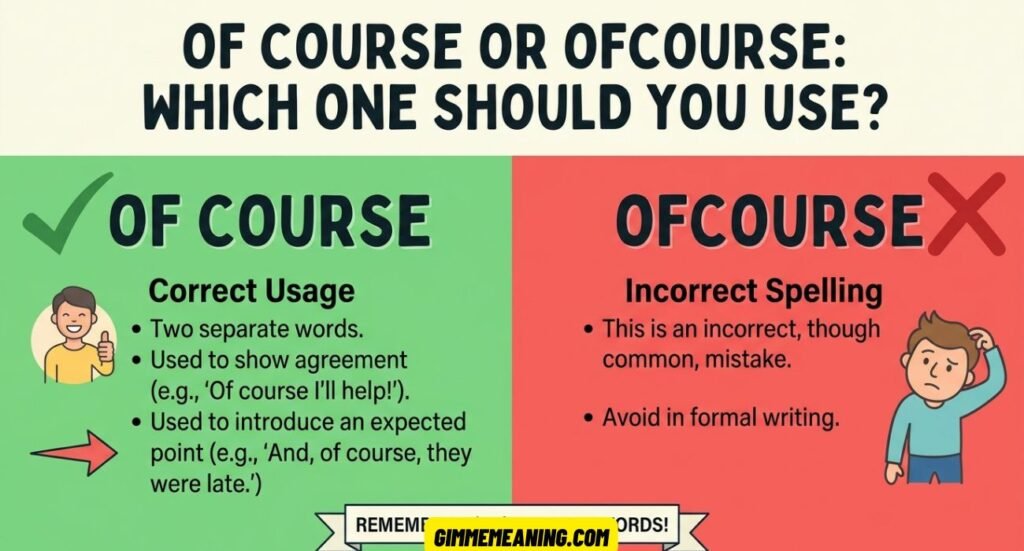
The phrase “of course” is used to show agreement, certainty, or something obvious. It is one of the most common English phrases used in daily conversations. It helps make responses sound polite, friendly, and natural in both formal and informal communication.
In simple terms, “of course” means certainly or without a doubt. It is often used in expressing agreement in English and showing certainty in sentences. This makes it a very useful phrase in both spoken and written communication.
How Of Course Works in Everyday English Usage
In everyday English usage, “of course” is used in many different situations. It can appear in casual conversations, professional emails, and even academic writing. Its flexibility makes it one of the most important conversational English expressions to learn.
For example, when someone asks for help, you can reply with “Of course.” This sounds polite and friendly. It is also commonly used in business communication language to show agreement and professionalism in workplace settings.
Grammar Rules for Writing Of Course Correctly
According to English grammar rules, “of course” must always be written as two separate words. This is a fixed phrase, and combining it into one word is considered incorrect in all types of writing, including formal and informal contexts.
When used in the middle of a sentence, it is often separated by commas for clarity. Following these simple grammar rules helps improve writing accuracy and prevents common spelling mistakes in English that can affect your overall communication.
See Also : What Does “Gimme” Mean? Definition, Usage
Formal vs Informal English: Where To Use Of Course
“Of course” works in both formal vs informal English, which makes it a very versatile phrase. In academic writing, it is used carefully to maintain a neutral tone, while in casual conversations it sounds friendly and natural.
In professional email writing tips, using “of course” shows politeness and respect. However, overusing it may sound repetitive or insincere. Understanding the tone is important when using this phrase in different communication situations.
Similar Phrases and Synonyms for Of Course
There are many synonyms for of course that can be used depending on the situation. Words like certainly, naturally, and without a doubt have similar meanings but slightly different tones in communication.
Using these alternatives helps improve vocabulary and makes your writing more engaging. It also helps you avoid repeating the same phrase too often, which improves writing quality and supports better correct word usage in different contexts.
Tips to Avoid Writing “Ofcourse” Incorrectly
To avoid writing “ofcourse,” it is important to practice correct spelling regularly. One simple trick is to remember that similar phrases like “a lot” and “all right” are also written as two words, not one.
Reading and proofreading your writing can also help catch mistakes. Over time, these habits improve your writing accuracy and help you avoid grammar mistakes examples that are common in both casual and professional communication.
FAQs
Which is correct, of course or ofcourse?
“Of course” is correct; “ofcourse” is a spelling mistake and not proper English.
When to say “ofcourse”?
You should never use “ofcourse”; always write “of course” as two separate words.
Is it correct to say “of course yes”?
It’s understandable but not natural; better to say “of course” or “yes, of course.”
Is it ofcourse or of cause?
Neither is correct here; the proper phrase is “of course,” while “of cause” has a different meaning.
Conclusion
The topic Of Course or Ofcourse is simple once you understand the basic rule. You should always write “of course” as two separate words. This form follows correct English grammar and appears in all good dictionaries. Many people make this mistake because they type fast or copy what they see online. You can improve your writing by using the correct form every time. Good spelling shows care, effort, and clear thinking.
You can use “of course” in school work, emails, and daily conversations. It helps you sound polite, clear, and confident. You should practice writing it in sentences to build strong habits. You can also check your work before you send or submit it. This small step will improve your grammar and writing skills over time. When you learn the correct form, you build a strong base in English.