
Nighttime or Night Time: Unraveling the Correct Spelling in American English
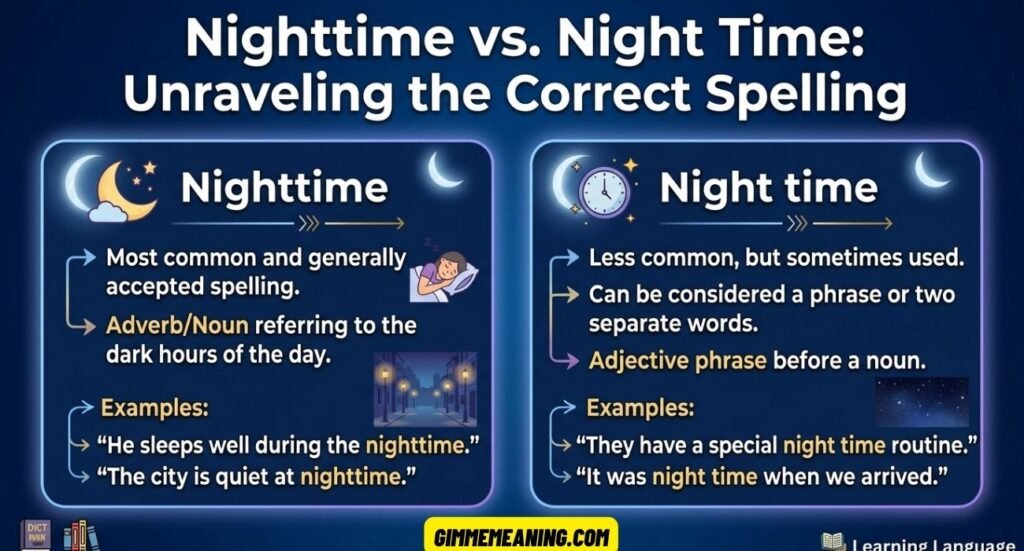
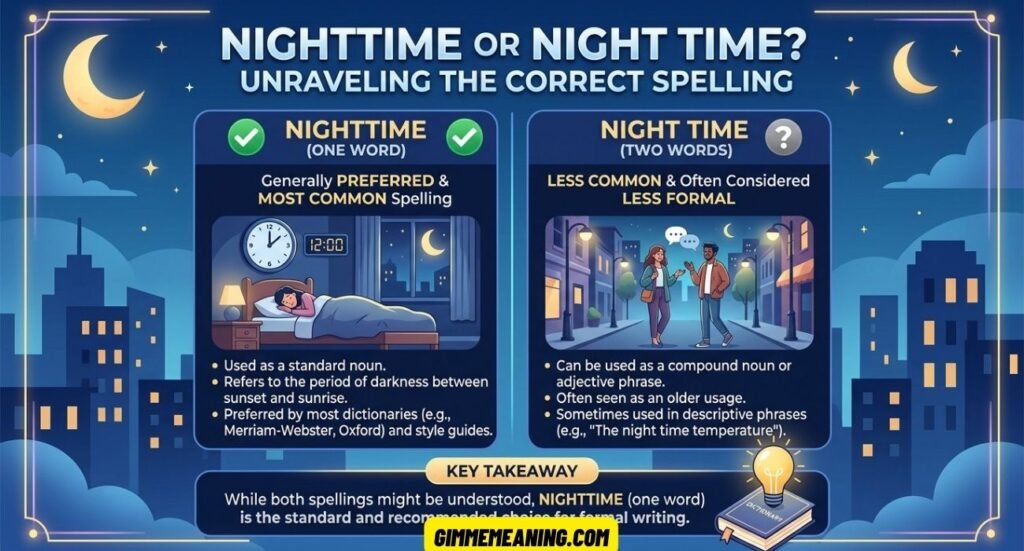
“Nighttime or Night Time” refers to the dark hours between sunset and sunrise. It describes the period when the sun is not visible. In modern English, “nighttime” is usually written as one word.
Many writers feel confused about which form is correct. Both versions look similar, but they are not used the same way. This small difference can change how your writing looks and feels.
In today’s English, “nighttime” is more common and widely accepted. It appears in books, articles, and school writing. Learning the correct form helps you write clearly and correctly every time.
Understanding the Basics: One Word vs. Two Words
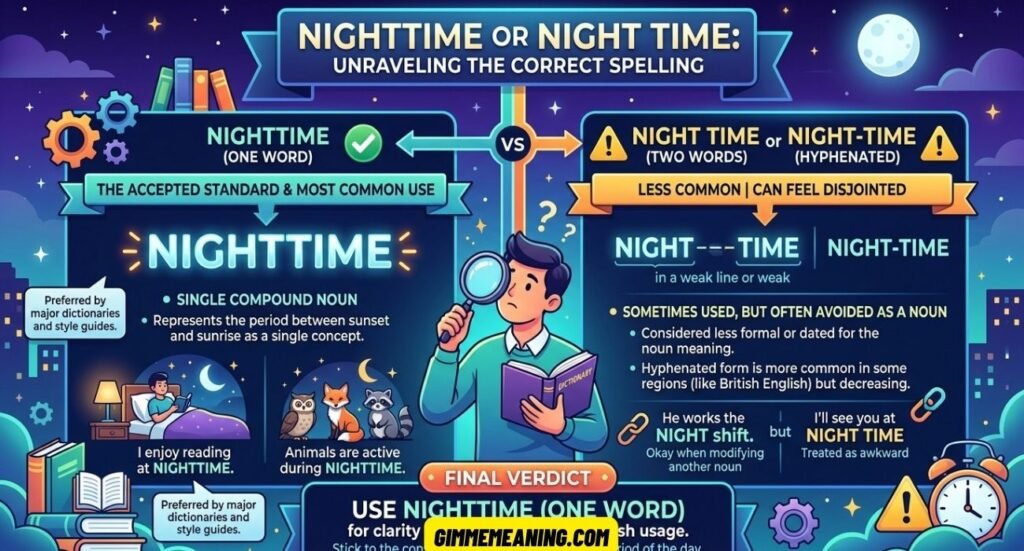
The confusion between night time or nighttime comes from how English words change over time. Both forms refer to the same idea, which is the period between sunset and sunrise, also known as the night hours meaning.
The modern and correct form is nighttime, which is written as one word. This is the standard in American English and is used in most formal writing. On the other hand, night time as two words is less common and feels outdated or stylistic.
To better understand the difference between nighttime and night time, look at the table below:
| Form | Usage Level | Example Sentence |
| nighttime | Modern, standard | She enjoys the quiet of the nighttime. |
| night-time | British usage | The night-time sky was beautiful. |
| night time | Old/stylistic | He feared the dangers of the night time. |
This clearly answers the question: is nighttime one word? Yes, in modern usage, it is.
Closed vs. Open Compounds
To fully understand this topic, you need to know about compound words in English. A compound word is made when two words join together to form a new meaning.
There are different types, including open compound vs closed compound forms. An open compound is written as two separate words, while a closed compound is written as one word.
Here is a simple comparison:
| Type | Example |
| Open compound | night time |
| Hyphenated | night-time |
| Closed compound | nighttime |
Over time, English follows clear English spelling rules where commonly used phrases become shorter and combine into one word. This is why closed compound words examples like “daytime,” “anytime,” and “everyday” are now standard.
Similar examples include:
daytime vs day time
anytime vs any time
everyday vs every day
These examples help explain nighttime spelling rules explained in a simple way.
Historical Development of the Term
The story of nighttime usage in English shows how language evolves naturally. In early English, writers often used “night time” because spelling was not fixed. Over time, people wanted faster and simpler writing, so the words merged.
This change is part of general correct word usage in English, where commonly used phrases become shorter and easier to write.
Timeline of Use
The development of the word can be clearly understood through this timeline:
| Period | Common Form Used |
| Middle English | night time |
| 18th–19th century | night-time |
| Modern English | nighttime |
This shift shows how English follows patterns and supports modern American English vocabulary.
What Dictionaries and Style Guides Say
If you want to follow an academic writing style guide, it is important to check trusted sources. Most major dictionaries agree on the correct spelling of nighttime.
| Source | Preferred Form |
| Merriam-Webster | nighttime |
| AP Stylebook | nighttime |
| Chicago Manual of Style | nighttime |
These guides are widely used in schools and publishing, which confirms the standard nighttime definition and spelling.
Usage Trends in American vs. British English
One important factor is American vs British spelling differences. In the United States, “nighttime” is clearly preferred. In the United Kingdom, you may still see “night-time” due to British English hyphenation rules.
This creates a difference in usage:
| Region | Common Form |
| United States | nighttime |
| United Kingdom | night-time |
This explains nighttime vs night-time UK differences and highlights US vs UK grammar differences.
Google Ngram Viewer Data
Studies of books and texts show clear trends. The use of “nighttime” has increased greatly over the past century, while “night time” has decreased.
This proves that modern writers prefer the closed compound form. It also answers questions like nighttime one word or two and shows the importance of following modern usage.
Grammatical Function of “Nighttime”
The word “nighttime” is flexible and can be used in different ways in sentences. Understanding these uses helps improve grammar tips for writers and ensures better communication.
As a Noun
As a noun, “nighttime” refers to the period of darkness. This is the most common use.
Here are some nighttime example sentences:
“She enjoys reading during the nighttime.”
“Nighttime brings cooler temperatures.”
These examples clearly show nighttime in a sentence and help learners understand proper usage.
As a Modifier
“Nighttime” can also describe something related to the night. This is common in everyday language.
Examples include phrases like nighttime routine meaning, nighttime safety, and nighttime activities.
For example:
“He follows a strict nighttime routine.”
“The city has strong nighttime security.”
This shows how to understand how to use nighttime correctly.
See Also : Gluing vs Glueing: Which Spelling Is Correct in American English
Common Mistakes and Misconceptions
Many people make mistakes when deciding is night time correct grammar. While it is not completely wrong, it is not recommended in formal writing.
Some common mistakes include mixing “nighttime” and “night time” in the same article, which creates confusion. Another mistake is using the outdated form in professional writing instead of following modern formal vs informal writing standards.
Writers should always focus on correct word usage in English to maintain clarity and credibility.
Real-World Usage Examples
Looking at real-world writing helps understand examples of nighttime usage.
In journalism, you might read:
“The city becomes more active during the nighttime.”
In fiction:
“The nighttime sky was full of stars.”
In older writing:
“They avoided traveling in the night time.”
These examples show the shift in nighttime usage in English.
Practical Guidelines for Writers, Students, and Professionals
For anyone asking when to use nighttime, the answer is simple. In almost all cases, especially in American English, you should use “nighttime.”
This applies to academic writing, business communication, and online content. Following proper English spelling rules ensures your writing looks professional.
If you are writing for a British audience, you may use “night-time,” but consistency is important. Always follow the same style throughout your work.
Rule of Thumb
A simple rule solves the confusion of night time or nighttime.
Use “nighttime” for modern, formal, and American English writing. Avoid “night time” unless you are quoting old texts or writing creatively.
Nighttime vs Night Time: Why This Confusion Exists
Many people struggle with nighttime vs night time because both forms look correct at first glance. English has many words that change over time, and this creates confusion. Writers often ask, which is correct nighttime or night time, especially when writing formal documents or academic content where accuracy is important.
The confusion also comes from how we speak. In conversation, “night time” sounds natural, so people write it that way. However, modern nighttime usage in English follows updated spelling rules. Understanding these changes helps improve writing and ensures correct communication in both casual and professional settings.
Is Nighttime One Word or Two in Modern English?
A common question is, is nighttime one word or should it be written separately. In modern American English, “nighttime” is written as one word and is considered the correct spelling of nighttime. This form is widely used in books, articles, and academic writing.
However, “night time” as two words still appears in older texts or creative writing. This leads to confusion about nighttime one word or two. The simple rule is to use “nighttime” in most situations, especially when writing professionally or following modern grammar standards.
Nighttime Meaning and How It Is Used Today
The nighttime meaning is simple. It refers to the period between sunset and sunrise, also known as the dark hours of the day. This meaning is the same whether you write it as one word or two, which is why many people get confused.
Understanding the nighttime definition helps you use it correctly in sentences. For example, people often talk about nighttime routines or activities. This shows how the word is used in daily life and helps explain proper nighttime usage in English.
See Also : Happy Holiday or Happy Holidays? Exploring the Difference
Night Time Meaning in Older and Creative Writing
The phrase night time meaning is the same as “nighttime,” but its usage is different. In older English texts, writers often used “night time” because spelling rules were not fixed. This form was common in poetry and storytelling.
Today, “night time” is mostly used for style or emphasis. Writers may choose it for creative effect, but it is not common in formal writing. This explains the difference between nighttime and night time and why modern writing prefers the one-word form.
Nighttime Grammar Rules Explained Simply
Understanding nighttime grammar rules is important for clear writing. In modern English, “nighttime” is treated as a closed compound word. This means it is written as one word and functions as a noun or modifier in a sentence.
Following these rules helps avoid mistakes like mixing forms or using outdated spellings. These simple nighttime spelling rules explained make it easier for writers to stay consistent. It also improves overall grammar and supports better communication in formal and informal writing.
Examples of Nighttime Usage in Daily Sentences

Looking at nighttime example sentences makes learning easier. For example, you can say, “I prefer working during the nighttime,” or “The city looks beautiful at nighttime.” These examples show how the word is naturally used.
These are also great examples of nighttime usage that help learners understand context. Seeing nighttime in a sentence allows writers to use it confidently in their own work and avoid confusion with the two-word version.
When to Use Nighttime in Formal and Informal Writing
Knowing when to use nighttime is important for different writing styles. In formal writing, such as essays or reports, “nighttime” is always preferred. It follows modern grammar rules and looks more professional.
In informal writing, like messages or stories, some people may still use “night time.” However, using “nighttime” is still better for consistency. Learning how to use nighttime correctly helps improve both formal and casual writing skills.
See Also : Deepest Sympathy Meaning, Usage, and Examples (Complete Guide)
Nighttime vs Night-Time UK: Understanding Regional Differences
The difference between nighttime vs night-time UK comes from regional spelling styles. In American English, “nighttime” is standard. In British English, the hyphenated form “night-time” is still commonly used.
These differences are part of larger American vs British spelling differences. Understanding these variations helps writers choose the correct form based on their audience. It also highlights important US vs UK grammar differences in modern English usage.
FAQs
Is nighttime one word or two?
“Nighttime” is one word in modern American English and is the correct standard spelling.
The two-word form “night time” is outdated and rarely used in formal writing.
What is night-time?
“Night-time” is a hyphenated form mainly used in British English.
It has the same meaning as “nighttime,” referring to the hours of darkness.
How do you use nighttime in a sentence?
“Nighttime” is used as a noun or modifier, like: “I enjoy the calm of nighttime.”
It can also describe things, such as “nighttime routine” or “nighttime activities.”
What is the difference between night and nighttime?
“Night” is a general term for the dark part of the day.
“Nighttime” specifically refers to the period or duration of the night.
Conclusion
Understanding nighttime vs night time helps you write clearly and correctly. The word “nighttime” is the modern and accepted form in American English. It follows simple spelling rules and looks more professional in school and work. Writers use it in essays, articles, and daily communication. Learning the correct form improves grammar and builds strong writing skills.
Using “nighttime” also helps you stay consistent in your writing. The two-word form “night time” is old and not common today. Good writers follow modern usage and clear rules. This makes their writing easy to read and understand. By learning the difference in nighttime vs night time, you can write with confidence and accuracy every day.