
Window Sill vs Window Seal: What’s the Difference?
You are halfway through describing a home repair — or writing up a listing, a report, a message to a builder — and the sentence stalls on one small choice: window sill or seal? The two words sit a single vowel apart, both belong to the same object, and picking the wrong one changes a ledge into a strip of rubber.
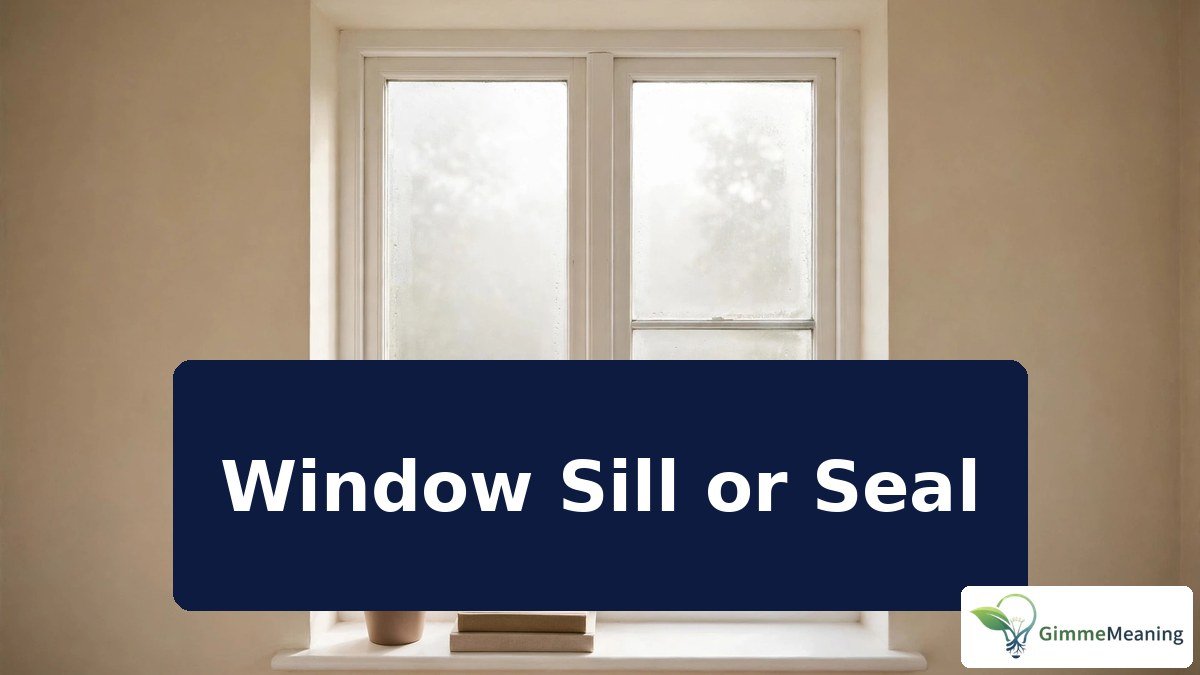
They are not two spellings of one thing. The sill is the flat ledge running along the window’s base — the part you can rest a plant on. The seal is the barrier that closes the gaps around the glass and frame — the part that keeps air and water out.
What follows separates them properly: what each part is, what the dictionaries record under the two words, where the sound-alike trap comes from, and the errors that collect around the pair.

Why People Mix Up “Seal” and “Sill”
Quick Answer: Choosing between window sill or seal? Let the job in your sentence decide. A ledge you can touch, paint and rest things on is the sill. A closure whose whole work is blocking air, water and dust is the seal. One belongs to the structure; the other is a barrier fitted to it.
The mix-up has three ingredients. The words differ by one vowel sound and nothing else, so the ear is a poor proofreader. Both words live in the same few centimetres of the same object, so context rarely rescues a wrong choice. And writers type the word they say most often — seal, the commoner word in everyday English — in places where the ledge was meant.
The example that gives the game away: “condensation had formed on the window seal” makes sense only if the moisture is on the glass or its edging. If the water is sitting on the ledge under the window, that ledge is the sill, whatever the sentence calls it.
Understanding the Root of the Confusion
The two words are often described as homophones. They are not — and the difference matters, because it is the whole trap. A homophone pair sounds exactly alike; this pair does not. Seal carries the long vowel of see, sill the short vowel of sit. Spoken slowly, nobody confuses them. Spoken at conversation speed, the vowel shrinks and the words land close enough together that the listener — and later the writer — has to reconstruct which one was meant.
Nor do the words share a root that might excuse the confusion. They arrived in English by entirely separate roads:
| Word | Pronunciation | Where it actually comes from | What it names |
|---|---|---|---|
| Seal | /siːl/ | Latin sigillum, “a little sign”, by way of Anglo-French | A closure that blocks the passage of air or water |
| Sill | /sɪl/ | Old English syll — a beam, a threshold, a foundation timber | The horizontal base member of a window or door |
Read the first row twice, because a version of this table circulates with the seal’s origin given as an Old English word meaning “to close or fasten”. No dictionary records that origin. The closing word seal is Latin by birth — it began as the stamp pressed into wax — while the Old English lookalike, seolh, is the animal that swims. The full record is set out in the dictionary audit and the history section below.
Window Sill or Seal in the Dictionaries: The Entries, Checked One by One
Spelling pages copy each other’s dictionary claims without checking them — one page in this pair’s orbit prints an origin for seal that no dictionary supports. So the table below was built the slow way: each entry opened, read, and reported as it stands.
| Dictionary | sill / windowsill | seal |
|---|---|---|
| Cambridge Dictionary | Both entered: sill — “a flat piece of wood, stone, etc. that forms the base of a window or door”; windowsill — “a shelf below a window, either inside or outside a building” | Entered in full: the barrier sense is “something fixed around the edge of an opening to prevent liquid or gas flowing through it”, alongside the wax-stamp and animal senses |
| Merriam-Webster | Both entered: sill — “the horizontal member at the base of a window”; windowsill — “the horizontal member at the bottom of a window opening”, first recorded in 1703 | Entered in full: among its senses, “a tight and perfect closure (as against the passage of gas or water)” |
| Oxford Learner’s Dictionaries | Sill entered — “(also windowsill, window ledge): a narrow shelf below a window, either inside or outside”, origin Old English syll, “horizontal beam forming a foundation” | Entered in full, barrier and stamp senses both recorded |
Three conclusions fall out of the entries. First, every dictionary treats the two as separate words for separate things — no entry anywhere offers one as a variant spelling of the other. Second, the ledge word is entered in both its forms, sill and the compound windowsill, which settles the spelling question the FAQs take up below. Third, the barrier word’s dictionary life starts with a stamp: the closure sense is the younger branch of a word whose first job was pressing a mark into wax.
What Is a Window Seal?
A window seal is the barrier that closes the gaps a window would otherwise leave — around the edge of the glass, between the panes of a sealed unit, and between the moving sash and the fixed frame. Cambridge’s phrasing is the plainest: something fixed around the edge of an opening to prevent liquid or gas flowing through it. Air and water are the two things a window is asked to stop, and the seal is the part that stops them.
Main Functions of a Window Seal
- Blocking draughts: a sound seal keeps heated or cooled air inside, so the room holds its temperature.
- Keeping water out: rain driven against the glass and frame is stopped at the seal line instead of tracking indoors, where it feeds mould and rot.
- Quietening the room: a closed gap is also a sound gap; sealing cuts the noise that leaks around a sash.
- Holding the gas in a sealed unit: in double glazing, the seal around the unit’s edge keeps its insulating gas fill in and moisture out.
Picture it as the window’s weatherproofing layer: thin, mostly hidden, and only ever noticed on the day it fails.
Types of Window Seals
| Type | How it works | Usual material | Where you meet it |
|---|---|---|---|
| Compression seal | A soft strip squeezed tight when the window closes | Rubber or foam | Casement and sliding windows |
| Brush seal | A dense row of fine bristles fills the gap and flexes as parts slide | Nylon or polypropylene pile | Sliding sashes and sliding doors |
| Magnetic seal | Two flexible magnetic strips pull together into a closed joint | Rubber with a magnetic core | Some modern window and door systems |
| Silicone gasket seal | A moulded, durable edging fitted around glass or frame | Silicone | High-performance and double-glazed units |
A practical habit worth keeping: look your seals over twice a year. Perished rubber, a strip that has flattened or cracked, and glass that fogs from the inside are all early warnings — the maintenance section below sets out the full list.
What Is a Window Sill?
A window sill is the horizontal member at the base of the window — Merriam-Webster’s definition, and the shortest accurate one available. Cambridge calls it the flat piece of wood or stone that forms the base of a window or door; Oxford calls it a narrow shelf below the window, inside or out. It is a solid, visible, touchable part of the building, which is precisely what the seal is not.
Primary Roles of a Window Sill
- Basing the window: the frame’s bottom member rests on and is finished by the sill; the windowsill, as the reference works put it, structurally supports and holds the window in place.
- Shedding water: the exterior sill is sloped so rain runs off its face instead of soaking into the wall beneath.
- Finishing the opening: indoors, the sill caps the bottom of the window reveal and gives the wall a clean edge.
- Serving as a shelf: the indoor ledge is where the plant pots, books and ornaments actually live — a side effect of the structure, and the use most people know it by.
Note the contrast with its partner: nobody has ever rested a plant on a seal. The sill is the one part of the window you use as furniture, and it can only play that role because it is structure first and surface second.
Types of Window Sills
| Type | Where it sits | Common materials | What defines it |
|---|---|---|---|
| Interior sill | The inside bottom edge of the opening | Wood, MDF, marble | The visible indoor ledge; finished for looks as much as for use |
| Exterior sill | Outside, at the foot of the opening | PVC, stone, aluminium | Angled so rain runs off its face instead of soaking into the wall |
| Sub-sill | Beneath the visible sill, hidden in the wall | Concrete or masonry | The structural course the visible sill rests on |
The interior member is the one homeowners misjudge: it reads as decoration, a shelf that happens to be there. It is in fact the top face of the window’s base — and, as the next section shows, it is not even, strictly, the sill.
The Carpenter’s Correction: The Inside Ledge Is a Stool
Here is the refinement the dictionaries leave to the trade. In the language of carpenters and window manufacturers, the shelf-like piece of interior trim at the bottom of a window — the ledge you actually put plants on — has its own technical name: the window stool. The sill, in the strict usage, is the sloped structural member at the base of the opening, largely an exterior part; the stool is the flat interior trim fitted against it.
Everyday English ignores the distinction, and the dictionaries side with everyday English: Oxford enters the shelf sense under sill itself (“also windowsill, window ledge”), and nobody ordering a “new window sill” from a supplier will be misunderstood. But the trade distinction explains a real puzzle — why the part you can see and touch indoors feels like furniture while the part the builder means by sill is mostly hidden in the wall. Both are real; they are simply not the same piece of wood.
One more spelling lives at this end of the window: in British building usage the sill is sometimes written cill, a variant the reference works record as less frequent. It names the same member — a spelling variant of sill, never of seal.
Comparing Window Seal vs Window Sill
| Feature | Window seal | Window sill |
|---|---|---|
| What it is | A barrier fitted around glass and frame | The horizontal base member of the opening |
| Job | Stops air, water and dust passing | Supports the frame’s base and sheds water off the wall |
| Made of | Foam, rubber, silicone | Stone, timber, PVC, metal |
| Where it sits | Around panes and between sash and frame | At the bottom of the window opening |
| How it fails | Perishes, flattens, cracks — draughts and fogged glass follow | Paint peels, wood rots, water pools on a level surface |
| Upkeep | Replace the strip or renew the sealant | Clean, repaint, repair or replace the member |
The one-line version: the seal stops leaks; the sill carries the base.
When to Use “Window Seal” Correctly
Reach for window seal whenever the sentence is about closing a gap — insulation, waterproofing, draughts, condensation, noise. Fresh examples:
- “A split window seal along the top rail was letting the January draught straight through.”
- “The surveyor blamed the misted glass on a failed seal in the double-glazed unit.”
- “She ran a new bead of sealant where the old window seal had shrunk away from the frame.”
Avoid seal for anything you could rest a cup on. If the thing in the sentence has a top surface, it is not a seal.
When to Use “Window Sill” Correctly
Reach for window sill — or the one-word windowsill, which the dictionaries enter as a headword in its own right — whenever the sentence concerns the base ledge the window sits in. Fresh examples:
- “A row of herbs in terracotta pots takes up most of the kitchen window sill.”
- “The exterior sill had rotted at one corner, and the paint came away in flakes.”
- “He left the keys on the windowsill, exactly where he always leaves them.”
One claim about these two spellings needs correcting, because it is repeated everywhere: that windowsill as one word is the British habit and window sill as two words the American. The dictionaries record no such split. Cambridge and Merriam-Webster both enter the one-word form as a headword — Merriam-Webster dates it to 1703 — and both spellings turn up in both varieties. Write either; be consistent; nobody’s dictionary will mark you wrong.
Historical and Etymological Background
The two words have been neighbours for centuries without ever being related, and their histories explain the modern confusion better than their sounds do.
Sill is the older, homegrown word. Merriam-Webster traces it to Middle English sille, from Old English syll — a beam, a threshold, a large timber serving as the foundation of a wall — with relatives across the Germanic family, including German Schwelle, a threshold. It was in use before the twelfth century, and its meanings still fan out from that base timber: the base of a window, the threshold of a door, the foundation plate of a timber frame, even a sheet of igneous rock lying flat between other strata. The window sense — the lower horizontal part of a window opening — is recorded from the early fifteenth century, and the compound windowsill from 1703.
Seal is an import with a disguise. The word for closing things comes from Latin sigillum — a little sign, a stamp — through Anglo-French seal, and enters English in the thirteenth century meaning the wax stamp and the impression it leaves. From the stamp came the thing stamped with it, then anything that secures a closure, and finally the modern barrier sense Merriam-Webster records as “a tight and perfect closure (as against the passage of gas or water)”. The animal that shares the spelling is a different word altogether — Old English seolh — which is why the “Old English seol, to close or fasten” origin printed in some versions of the comparison table is a phantom: it welds the animal’s ancestor onto the stamp’s family tree.
In short: the sill is a foundation that became a ledge; the seal is a stamp that became a barrier.
Why the Wrong Word Feels Right: The Pull of the Near-Identical Pair
Errors run toward the familiar, and this pair is engineered for them. The words differ by a single vowel; they occupy the same object; and seal is by far the commoner word in daily life — envelopes are sealed, deals are sealed, containers are sealed — so when a writer reaches for the window word at speed, the hand comes back with seal whether the ledge was meant or not.
It is the same trap that catches people over pairs all over this site. Our article on what well said mean turns on two settled expressions, well said and well spoken, that look interchangeable until you ask what each one actually praises. Here the test is physical rather than social: ask what the thing in your sentence does. A part that blocks is a seal; a part that bears and sheds is a sill. The ear cannot settle the pair, so the meaning has to.
Common Phrases and Everyday Uses
Window Seal in Everyday Life
- “Broken window seal” — in practice this usually means the seal of a double-glazed unit has failed, and the evidence is condensation trapped between the panes.
- “Seal the window” — the verb at work: to apply sealant, caulk or weatherstripping around a frame so the gaps close.
- “Window seal replacement” — the job a glazier quotes for when a unit has misted or a perimeter strip has perished.
Window Sill in Common Use
- “She lined the window sill with jars of cuttings, each one rooting in water.”
- “The cat sleeps on the sunny sill above the radiator.”
- “Rain had pooled on the exterior sill where the slope had worn flat.”
The contexts sort themselves: if weather is being kept out, the sentence wants seal; if something is being stood on a ledge, it wants sill.
Preventing Mistakes in Writing and Construction
Quick Memory Trick
Two verbs settle it: seal = stop; sill = support. If the part’s job is to stop something — air, water, dust — it is the seal. If its job is to support, carry or shed, it is the sill.
Writing Tip
Test the sentence by substitution. Replace the word with barrier: if the sentence still works, seal was right. Replace it with ledge: if that works, the word you want is sill. A sentence that survives neither substitution is probably about the frame, which is a third thing entirely.
Construction Tip
Order by job, not by sound. For energy efficiency and weatherproofing you want sealant, weatherstripping and gasket seals. For the base of the opening you want sill boards, sill sections or capping sills. Saying the quiet part — “the ledge” or “the draught-proofing” — when you order saves the wrong delivery.
Maintenance and Replacement Insights
Signs Your Window Seal Has Failed
- Condensation or fogging trapped between the panes of a double-glazed unit.
- A draught you can feel at the frame’s edge with the window shut.
- Heating bills creeping up as sealed gaps reopen.
- Rubber strips that have cracked, flattened or pulled away from the corner.
The fixes divide by which seal has gone. Perimeter seals and weatherstripping can be renewed by a careful homeowner: old sealant out, edges cleaned, new sealant or strip in. A failed seal inside a double-glazed unit is a different matter, for reasons the next section gives — that one is a glazier’s job, and usually means a new unit.
Signs Your Window Sill Needs Repair
- Paint cracked or peeling along the top face.
- Soft, darkened wood — rot — especially at the exterior corners.
- Water standing on the sill after rain instead of running off it.
Repairs scale with the damage: sound wood can be sanded, primed with a waterproof primer and repainted; localised rot can be cut out and filled; a sill rotted through its section has to be replaced, because the base of the window is not a part that can be left soft.
The Seal Inside the Glass: What “Failed Seal” Really Means
The commonest “window seal” failure of all happens somewhere most people never think to look: inside the double-glazed unit itself. A sealed unit is two panes of glass held apart by a spacer around their edges. On a factory line, a primary sealant — polyisobutylene — is applied to the faces of that spacer and the panes pressed against it; its whole purpose is to keep the insulating gas in and water vapour out. A secondary sealant, usually polysulfide or silicone, is then wrapped around the unit’s edge to hold the assembly together, and the spacer carries a desiccant that mops up whatever moisture was trapped inside during manufacture.
That is why a “failed seal” mists the glass. Once the edge seal is breached, moist air works its way into the cavity faster than the desiccant can absorb it, and condensation forms on the inside faces of the panes — surfaces no cloth can reach. It is also why the failure cannot be cured with a tube of sealant from outside: the barrier that failed is inside a factory-made sandwich. The remedy is a replacement unit, fitted by a glazier. When a quote for “window seal repair” seems to involve new glass, this is the reason.
Case Study: Energy Efficiency in Modern Homes
This section of the page you may have read elsewhere carries a confident set of figures, attributed to a 2022 energy audit said to cover five hundred Midwest homes: forty-three per cent of them with degraded seals, poor seals costing up to a quarter more heat, proper sealing saving somewhere between 120 and 250 dollars a year, water getting past damaged sills in eighteen per cent of homes and mould in thirty-two. Those numbers are not carried here, for a simple reason: the audit cannot be traced. No organisation is named as having run it, no report is cited, and no published study matching the description can be found. Percentages without a source are decoration, not evidence.
What survives without the invented arithmetic is the underlying point, and it needs no percentages: a window whose seals have failed leaks heated air all winter, and a sill whose slope or paint has failed lets water into the wall. Both are cheap to inspect and expensive to ignore. That claim rests on what the parts do — set out in the sections above — rather than on a study nobody can produce.
Final Comparison Summary
| Aspect | Window sill | Window seal |
|---|---|---|
| Definition | The base member and ledge along the window’s bottom edge | The barrier closing the window’s gaps against air and water |
| Location | The bottom edge of the window opening | Around the glass, and between sash and frame |
| Main function | Support, finish and drainage | Insulation and weatherproofing |
| Common materials | Timber, PVC, stone, metal | Silicone, foam, rubber |
| Maintenance | Paint, repair and reseal the surface periodically | Replace when cracked, flattened or loose |
| Failure sign | Peeling paint, soft wood, standing water | Draughts at the frame; fog between panes |
Both parts are essential, and neither can do the other’s job: a perfect sill under a perished seal still leaks heat, and a perfect seal over a rotted sill still lets the wall get wet.

Quick Quiz: Seal or Sill?
- The rubber strip that keeps the draught out is the window’s ___.
- You have just rested a plant pot on the ___.
- Fog appears between the panes of a double-glazed window. Which part has failed?
- Which of the two words descends from Latin sigillum, a little sign or stamp?
- True or false: in the carpenter’s strict usage, the inside shelf of a window is called the stool.
Answers: 1. Seal. 2. Sill. 3. The seal — the edge seal of the sealed unit. 4. Seal. 5. True — the sill proper is the structural base member; the interior trim shelf is the stool.
FAQs About Window Seal vs Window Sill
What’s the main difference between a window seal and a window sill?
The seal is a barrier: it closes the gaps around glass and frame so air and water cannot pass. The sill is a structure: the horizontal base member of the window, which finishes the bottom of the opening and sheds water off the wall. If you can rest something on it, it is the sill; if it works by being squeezed, stuck or fitted into a gap, it is the seal.
Can I fix a broken window seal myself?
Partly. The seals you can reach — weatherstripping, perimeter gaskets, the sealant bead around a frame — can be renewed at home with the old material stripped out and the edges cleaned first. The seal you cannot reach is the one inside a double-glazed unit: when that fails and the glass mists between the panes, the unit itself has to be replaced, and that is a glazier’s job.
Is it spelled “window sill” or “windowsill”?
Both spellings are correct, and both are entered in the dictionaries: window sill as two words, and windowsill as a single-word headword in Cambridge and Merriam-Webster — the compound is recorded as far back as 1703. The often-repeated rule that the one-word form is British and the two-word form American is not one the dictionaries record; both forms appear in both varieties. Pick one and use it consistently.
How often should I replace window seals?
No dictionary or checkable authority sets a fixed interval, and the “every 10 to 15 years” figure that circulates on pages like this one comes with no source attached — treat it as a rough guess, not a schedule. Seals are replaced on condition, not on calendar: when a strip has cracked, flattened or shrunk, when a draught returns at a closed window, or when a sealed unit starts to mist, that seal is due, whatever its age. A sheltered seal can outlast the guess; a sun-beaten one can fail well inside it.
What materials make the best window sills?
It depends on which face of the wall the sill serves. Outside, where the sill’s job is to shed weather for decades, stone and PVC stand up best; both shrug off water that would rot timber. Inside, where the ledge is also furniture, wood and marble are the usual choices — wood for warmth and easy repair, marble and stone where a hard, cool surface is wanted. The material matters less than the slope and the finish: a sill that throws water clear and keeps its paint will outlast a better material left level and peeling.
Conclusion
Name what each word actually refers to, and the choice settles itself. The choice between window sill or seal is a choice between the ledge and the barrier: the sill is the window’s base — solid, visible, sloped to shed water, Old English syll, a foundation timber by ancestry — and the seal is its closure, a Latin stamp-word that came to mean anything that shuts a gap tight. One you can stand a plant on. The other you can only detect by the draught that announces its failure.
When the next sentence, order or repair note is yours to write, run the substitution test: barrier or ledge, stop or support. Cambridge’s windowsill entry compresses the whole distinction into a single line — “a shelf below a window, either inside or outside a building” — and a shelf, by definition, is something you can put things on. No seal ever made could hold a plant pot.





One Comment