
Next Friday vs This Friday: What’s the Difference?
Next Friday vs this Friday has emptied meeting rooms: one person arrives this week, the other seven days later. The phrases are short, the gap between them is a full week, and the only reliable way to answer “what day is next Friday?” is to start from today.
The short answer: this Friday is the Friday of the week you are in; next Friday, on the standard reading, is the Friday of the week after. Both phrases move with the day you say them — which is exactly where the trouble starts.
What follows pins both phrases to the day you are standing on: a day-by-day table, the two readings of next, the British escape hatch Friday week, eight worked examples, and a quiz — ending with the one habit that ends the argument.

Understanding the Core Difference Between “This Friday” and “Next Friday”
Quick Answer: what day is next Friday? On the standard reading, the Friday of next week — the Friday that comes seven days after this Friday. Said on a Monday, that makes it eleven days away; said on Friday itself, exactly seven. This Friday is always the nearer one: the Friday of the week you are standing in.
Strip both phrases down and each is an anchor plus a day. This anchors the day inside the current week; next pushes it into the following one:
- This Friday — the Friday of the week you are in now.
- Next Friday — the Friday of the week that follows this one.
Why the Definition Is Only the Start
The definition is the easy part.
The difficulty is that “the week you are in” feels different depending on the day you say it: on Monday the current week has a Friday still to come, on Friday the week’s Friday is today, and on Sunday the week is either just ending or just beginning, depending on the calendar you grew up with.
The table below is the standard reading, with the day counts spelled out:
| Today | “This Friday” Refers To | “Next Friday” Refers To |
|---|---|---|
| Monday | The Friday of this week, 4 days away | The Friday of next week, 11 days away |
| Thursday | Tomorrow | The Friday of next week, 8 days away |
| Friday | Today itself | The Friday of next week, 7 days away |
| Sunday | The coming Friday, 5 days away | The Friday of the following week, 12 days away |
How Context Shifts the Meaning
Neither phrase carries its meaning alone. Each one is measured from today, and today keeps moving — so the same two words, spoken on different days, point at different dates. What shifts is not the definition but the distance, and the distance is where listeners part company.
Early Week (Monday–Tuesday)
Early in the week the split is at its widest, and agreement is at its strongest. The current week still holds a Friday ahead of you, so this Friday takes it, and next Friday takes the one beyond:
- This Friday = the Friday a few days away, inside this week.
- Next Friday = the Friday of the following week.
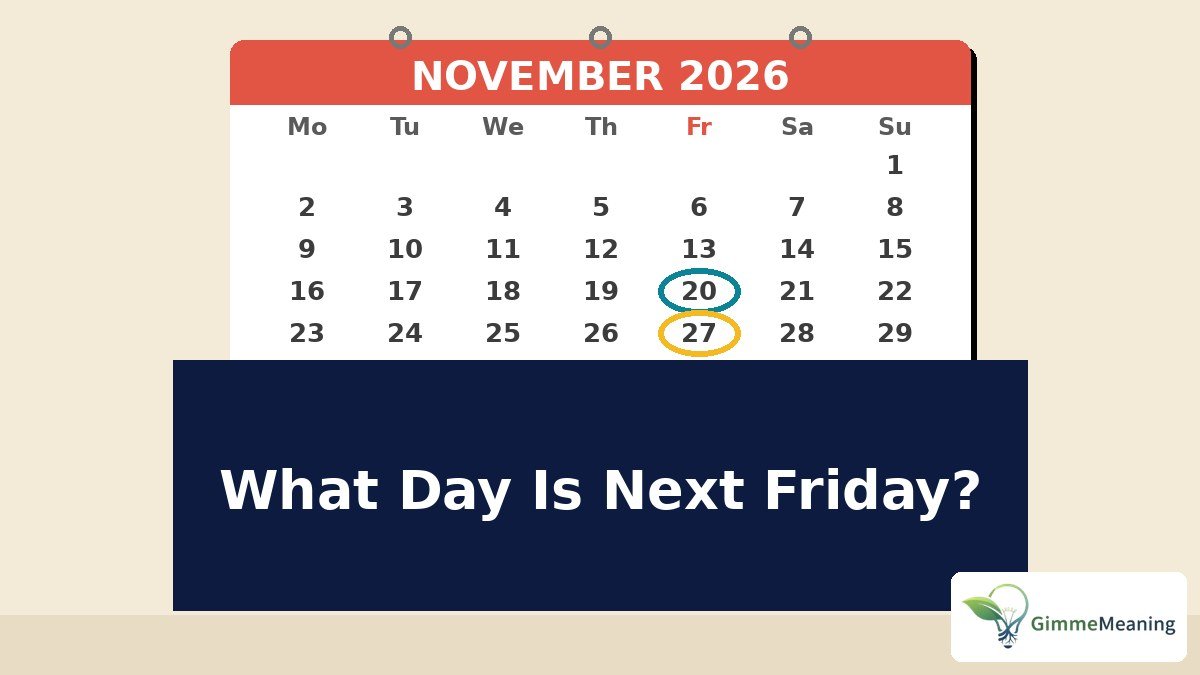
Stand on Monday the 10th and the pair resolves cleanly: this Friday is the 14th, next Friday is the 21st. Early-week speakers almost never collide, because the nearer Friday is too close to be argued over.
Midweek (Wednesday–Thursday)
By Wednesday the nearer Friday is two days off; by Thursday it is tomorrow. The current week now feels nearly spent, and some speakers start treating the close Friday as the start of the next block of plans — calling it next Friday when they mean tomorrow’s. Nothing about the definition changed; the week’s centre of gravity moved.
The practical rule for midweek: the closer this Friday gets, the more carefully next Friday needs handling. A plan that matters should never ride on the word next alone on a Thursday.
End of the Week (Friday–Sunday)
On Friday itself the pair locks into its clearest shape: this Friday is today, and next Friday is seven days away — the one arrangement every speaker shares. Across the weekend the ground shifts again.
On Saturday and Sunday, this Friday reaches forward to the coming Friday, five or six days ahead, rather than back to the one just passed, while next Friday stretches to twelve or thirteen days away. Most cross-purpose conversations about these phrases are born in this stretch of the week.
What Day Is Next Friday? Start From Today
Every row of the argument fits in one table. Find the day you are speaking on, and read across:
| Day You Say It | “This Friday” Is | “Next Friday” Is |
|---|---|---|
| Monday | 4 days away | 11 days away |
| Tuesday | 3 days away | 10 days away |
| Wednesday | 2 days away | 9 days away |
| Thursday | Tomorrow | 8 days away |
| Friday | Today | 7 days away |
| Saturday | 6 days away | 13 days away |
| Sunday | 5 days away | 12 days away |
Read the table by its gaps and the pattern shows itself: the two phrases are always exactly seven days apart, on every row.
What changes is only how far away the nearer one sits — and it is that distance, not the definitions, that listeners disagree about. A next Friday eleven days off feels safely distant on a Monday; the same phrase spoken on a Thursday sits one day from tomorrow, and the ear starts pulling it closer.
One Real Week, Dated
A real week makes it concrete. Take Monday 16 November 2026: this Friday is 20 November, and next Friday is 27 November. Nothing about the phrases changed between the table and the calendar — the dates were inside them all along, waiting for a “today” to measure from.
That habit — measuring a phrase from the day in front of you instead of trusting how it sounds — is the same habit that settles damnit or dammit: in both cases the answer comes from checking what the words actually do, not from which version feels familiar.
8 Real-Life Examples: How “This Friday” and “Next Friday” Change
Eight ordinary sentences, each pinned to the day it is spoken:
Example 1: Monday Conversation
“The dentist can see you this Friday.” ✅ Means: the Friday of this same week, four days away — the nearest Friday there is.
Example 2: Tuesday Discussion
“Let’s move the call to next Friday.” ✅ Means: not the Friday three days away, but the one ten days away. 💡 Tip: the sentence is safe only if both diaries agree — “next Friday, the 21st” makes it certain.
Example 3: Wednesday Chat
“The plumber is coming this Friday.” ✅ Means: this week’s Friday — the day after tomorrow.
Example 4: Thursday Meeting
“Save me a seat next Friday.” ⚠️ Possible confusion: tomorrow, or eight days from now? ✅ Clarify: if you mean the later one, say “Friday next week” and add the date.
Example 5: Friday Morning
“The report is due next Friday.” ✅ Means: one full week from today — the reading nobody argues with.
Example 6: Saturday Text
“We’re driving up this Friday.” ✅ Means: the Friday six days from now, the one coming up. The weekend speaker reaches forward, not back to yesterday.
Example 7: Sunday Planning
“Next Friday suits us for the house viewing.” ✅ Means, on the standard reading: the Friday of next week, twelve days away — not the one in five days. Because some speakers do mean the nearer one on a Sunday, this is a sentence worth a one-line confirmation.
Example 8: Workplace Scenario
“The client demo is this Friday.” ✅ Means: the upcoming Friday inside the same business week. Offices run on a shared workweek, which keeps this steady — but the calendar invite should still carry the date, not the phrase.
Common Misconceptions About “Next Friday”
Three misunderstandings account for nearly every missed meeting this pair causes:
1. Assuming “Next Friday” Always Means Seven Days Away
It does not — and the arithmetic shows why. Seven days is the distance between the two Fridays, not the distance from today to next Friday.
Stand on a Monday and next Friday is eleven days away; stand on a Wednesday and it is nine. The seven-day figure is true in exactly one seat: spoken on Friday itself, when next Friday is precisely a week ahead.
2. Different Week Start Days
Calendars do not agree on where a week begins. Cambridge’s entry for week prints both spans in a single definition — “from Monday to Sunday or from Sunday to Saturday” — because both conventions are in everyday use.
On a Sunday-start calendar, Sunday opens a brand-new week; on a Monday-start calendar, the same Sunday closes the old one. The day counts in the tables above never change, but which week a Sunday speaker feels they are standing in can tilt what this Friday means to them.
3. Casual vs. Professional Context
In relaxed speech, next often stretches to mean little more than “upcoming” — the next Friday you will ever meet. In scheduling, deadlines and diaries, the word is read strictly: the Friday of the following week.
Neither reading is a mistake in its own setting. The trouble starts when a sentence is spoken casually and filed professionally, so match the precision of the phrase to the cost of getting it wrong.
How Days of the Week Shape Understanding
Your mind keeps a mental week the way it keeps a mental map, and this Friday is located by feel before it is located by counting. Early in the week, Friday still belongs to the present — it is the day this week is heading toward.
By Thursday, the week feels finished even though a day remains, and Friday starts to feel like it belongs to whatever comes next. Over the weekend, the mind quietly opens a fresh week and files the coming Friday inside it.
| Day You Speak | “This Friday” Feels Like | “Next Friday” Is |
|---|---|---|
| Monday | This week’s, 4 days away | 11 days away |
| Thursday | Tomorrow | 8 days away |
| Saturday | The coming Friday, 6 days away | 13 days away |
The counts never move. Only the feeling does — and feelings, not counts, are what people act on when they nod at the phrase.
“This Friday” Explained
This Friday names the Friday that belongs to the week you are currently in. Its whole job is nearness: of the two Fridays in play, it always takes the closer one.
When It’s Used
- Monday to Thursday: the upcoming Friday of the current week, still ahead of you.
- On Friday itself: today — the week and the day arrive together.
- On Saturday and Sunday: the coming Friday, five or six days ahead. Speakers reach forward to it rather than back to the Friday just gone.
Examples
- “The exhibition opens this Friday.” ✅ Listeners place it inside the current week.
- “Can you send the invoice this Friday?” ✅ The nearest Friday on the calendar.
“Next Friday” Explained
Next Friday names the Friday of the following week — the one that arrives after the current week ends. Where this takes the nearer Friday, next always takes the farther one.
Key Points
- Next pushes the day across the week boundary, into the week after this one.
- It is never the same day as this Friday: the pair is always seven days apart.
- Spoken on a Friday, it produces the one reading every speaker shares — seven days ahead.
Example
“I’ll hand in the keys next Friday.” ✅ Means the Friday of next week, not the one a few days away.
Picture it on the calendar: today is Monday the 10th. This Friday is the 14th. Next Friday is the 21st — the same weekday, one full week later.
The Two Readings of “Next”: The Coming Friday, or the One After It
The split is not carelessness; it is built into the word itself. Cambridge defines next as “being the first one after the present one or after the one just mentioned” — and those two anchors, the present one and the one just mentioned, are precisely the two readings of next Friday.
Anchor on the present moment, and the next Friday is the first Friday after now: the coming one. Anchor on the Friday just mentioned — the one this Friday names — and the next Friday is the first Friday after that: a full week later.
When a conversation holds both phrases, logic settles it: this takes the near Friday, so next takes the one beyond. When next Friday stands alone early in the week, many speakers quietly run the first anchor instead. Both speakers are reading the same definition; they are standing on different halves of it.
Avoiding Confusion: How to Communicate Clearly
Four habits remove the ambiguity entirely:
1. Add the Date
“Let’s meet Friday, November 21.” ✅ A date has exactly one reading, in every week convention and every time zone.
2. Specify the Week
“Friday this week” or “Friday next week.” ✅ The week word does the anchoring openly, instead of leaving next to do it silently.
3. Confirm When Plans Matter
For work, travel or deadlines, echo the date back: “Just to confirm — Friday the 21st?” Ten seconds of echo is cheaper than a week of drift.
4. Use Technology
Put the plan in a calendar invite. The stored date, not the spoken phrase, becomes the agreement — and both sides can check it without re-arguing the sentence.
Regional and Cultural Variations
What varies by place is not the phrases but the scaffolding around them: where the calendar starts the week, and which extra forms the local variety keeps in stock.
| Variety | Week Usually Starts | The Tool That Helps |
|---|---|---|
| United States | Sunday | The date itself — Friday week is rarely heard |
| United Kingdom | Monday | Friday week names the later Friday outright |
| International (ISO) calendars | Monday | Write the date in full in the invite |
No dictionary settles the phrase itself. The entries define the words — next, this, week — and leave the anchoring to the speakers, which is why the date remains the referee wherever conventions meet.
“Friday Week”: The British Form That Ends the Argument
British English keeps a spare form for exactly this problem. Oxford’s entry for Friday labels Friday week British English — “Come back Friday week” — and Cambridge’s entry for week files the same phrase under the sense “one week after the day mentioned”. Both records point the same way: count forward to the coming Friday, then add one week.
Said on Monday the 16th, Friday week lands on 27 November — the very day the strict reading calls next Friday, named so that no second reading exists. Its partner, a week on Friday, works identically; Cambridge prints “Our holiday starts a week on Saturday” under the same sense.
Where these forms are understood, they end the argument. Where they are not — across much of the United States, they will draw a blank look — the date does the same job.
Quick Reference Table
| Situation | Say This | People Usually Mean | Best Practice |
|---|---|---|---|
| It is Monday | “This Friday” | The Friday of this week | Confirm with the date |
| It is Friday | “Next Friday” | The Friday seven days away | Add the date |
| It is Saturday | “This Friday” | The upcoming Friday | Say “Friday this week” and the date |
| It is Sunday | “Next Friday” | The Friday of next week | Clarify before planning |

Quick Quiz: Which Friday Did They Mean?
Five sentences, five different days. Commit to a date before you check the verdicts.
Clear-Cut Answers
1. It is Wednesday, and a colleague says, “The workshop is next Friday.” — Nine days away. The Friday of next week, not the one in two days.
2. It is Friday morning: “Let’s submit it next Friday.” — Seven days away. Spoken on Friday, next Friday is the following week’s.
3. It is Saturday: “We’re visiting this Friday.” — The coming Friday, six days away.
The Two That Trip People Up
4. It is Thursday: “See you next Friday.” What should you do? — Ask. The standard reading is eight days away, but Thursday is where the two readings collide; confirm the date before you travel.
5. It is Monday the 10th, and a British colleague says “Friday week.” — The 21st — the coming Friday, the 14th, plus one week.
Five from five means the phrases have stopped being a coin toss: you are reading them from the day, not from the sound.
When “Next Friday” Means Something Else
Three settings bend the phrase away from the calendar reading:
1. Workweek Reset
Where the working week starts on Monday, Friday is felt as the week’s finish line. Once the finish line is crossed, next Friday jumps the boundary by reflex — it is heard as the Friday of the next working week, whatever day the sentence is spoken on.
2. Calendar Apps
An invite stores a date, not a phrase. Once a plan is in the calendar, the argument is over — the date on the screen is what both sides agreed to. The risk lives entirely in the spoken sentence that created the invite, which is why the date should be spoken before the invite is sent.
3. Academic or Cultural Calendars
Terms, timetables and weekly observances run on week shapes of their own. Inside them, next Friday often means the Friday of the next scheduled cycle — the next exam day, the next gathering — rather than a bare calendar square. The anchor habit still applies: name the date.
The Smart Habit: Always Anchor Your Fridays
One habit removes the risk entirely: never let either phrase travel alone. Pair it with the date — “next Friday, the 27th” — and the sentence becomes unmisreadable in every convention at once.
The habit earns its keep in:
- Deadline emails at work
- Invitations to events people travel for
- Group chats that span time zones
Picture a software team that ships on Fridays. Half the team hears “the release moves to next Friday” as this week’s Friday; the other half hears the following week’s, and the launch lands seven days late. Nobody in that picture misheard a word — one unanchored phrase did all the damage. Dates over vague Fridays, every time.
The Same Trap in “Next Week”, “Next Month” and “Next Tuesday”
Friday is not the only place the two anchors collide. Say next Tuesday on a Monday and the standard reading puts it eight days away — yet plenty of listeners hear tomorrow.
Next month wobbles at the turn of a month in the same way, and even next week can split when it is spoken on a Sunday that two calendars file in different weeks.
The Week After Next
English keeps a spare step for climbing one level further: the week after next. Cambridge’s own example sentence runs “Can we arrange a meeting for the week after next?” — the phrase exists precisely because next alone could not be trusted to climb high enough.
The repair is the same everywhere it applies: anchor the phrase to a date, and the trap closes.
FAQs About “Next Friday” vs “This Friday”
What does “this Friday” mean if today is Friday?
It means today. This anchors the day inside the week you are standing in, and on Friday that day is the present one. For the Friday seven days ahead, say next Friday — or add the date.
If it’s Sunday, does “this Friday” mean the upcoming one?
Yes — the Friday five days ahead. Sunday sits on a week boundary, so speakers reach forward: this Friday names the Friday of the week just beginning, not the one two days behind you.
Why do people interpret “next Friday” differently?
Because next carries two live anchors. Dictionaries define it as the first one after the present one — or after the one just mentioned. Anchor on today and you get the coming Friday; anchor on this Friday and you get the week after.
Can I say “Friday next week” instead of “next Friday”?
Yes, and it is the clearest short fix. Friday next week pins the day to next week and leaves no second reading standing. Clearer still is the date itself: “Friday the 27th” cannot be misread at all.
How do I teach this to English learners?
Draw two weeks on a calendar. Mark today, shade this Friday, then next Friday, and say each phrase while standing on different days. The phrases only make sense against a visible “today” — the calendar supplies it.
Summary
- This Friday → the Friday of the week you are in.
- Next Friday → the Friday of the following week.
- The meaning shifts with the day you speak — most sharply after Thursday.
- Use dates, or “Friday this week” and “Friday next week”, when the plan matters.
- Week conventions differ by place — confirm when a plan crosses them.
So what day is next Friday? The Friday of next week — and now you can prove it from any day of the week, name the reading your listener is using, and repair the sentence before it costs anyone seven days.
Underneath every reading sits the same unit: the week — seven days that calendars arrange from Monday to Sunday or from Sunday to Saturday, depending on where they are printed. Anchor your Fridays to a date, and the week can start wherever it likes.



One Comment