
Real Life or Real-Life? Which Is Correct and When to Use the Hyphen
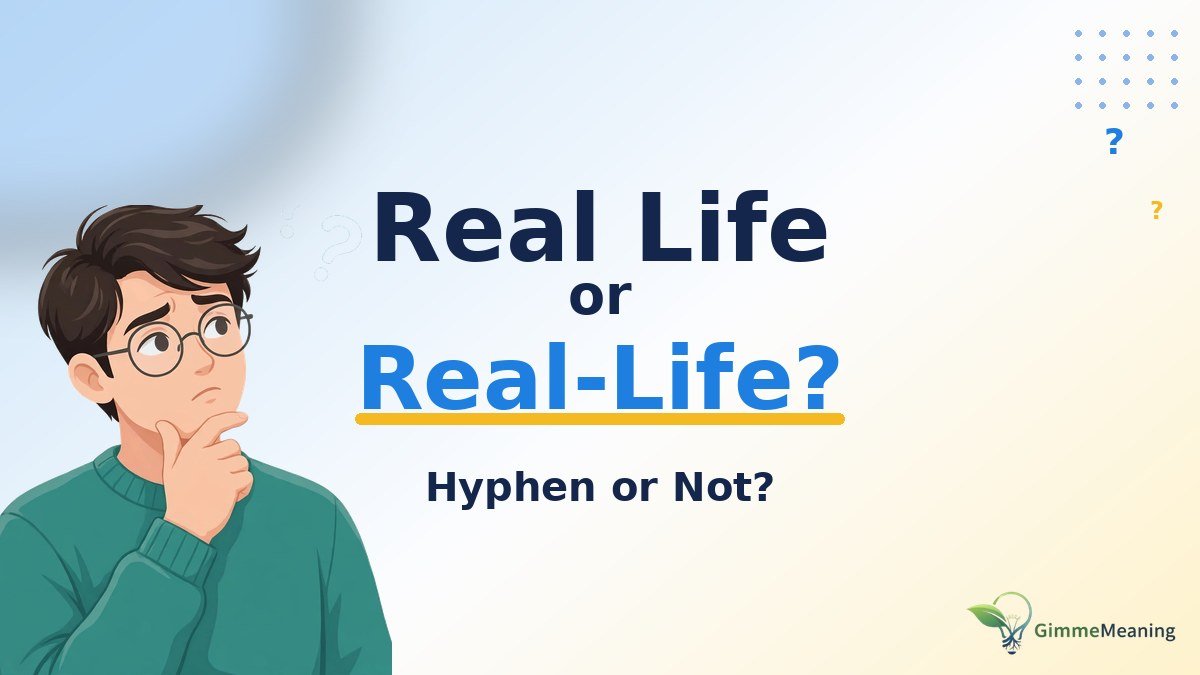
One tiny dash, two correct answers — that’s the puzzle of real life or real-life. Both spellings are right, and that’s exactly what makes the choice feel wrong: you can type either one, stare at it, and talk yourself out of it. The difference isn’t the words. It’s the job they’re doing in your sentence.
Here’s the whole rule in one breath. Real life, with no hyphen, is a noun phrase — it names the actual world outside books and screens. Real-life, with the hyphen, is an adjective — it stands in front of a noun and describes it, as in “a real-life rescue”.
This page works through the choice properly: the grammar underneath it, what the major style guides actually say, the British angle, the mistakes that give writers away, and a two-second test that settles the question every time.
Why Writers Get Confused About “Real Life”
Quick answer: write “real life” with no hyphen when the phrase is the thing itself — a noun naming actual experience (“In real life, nobody talks like that”). Write “real-life” with a hyphen when it works as an adjective in front of a noun (“a real-life witness”, “real-life delays”).
The confusion is understandable: your ear hears no difference between the two forms, your eye barely registers one, and both turn up constantly in well-edited writing — sometimes in the same paragraph. Add the fact that English hyphenation genuinely shifts over time (words like “e-mail” shed their hyphens and became “email”), and it’s no wonder writers hesitate.
But notice what the hesitation is really about. It isn’t spelling — nobody is choosing between a right word and a wrong one. It’s punctuation doing a grammar job: the hyphen signals that two words have teamed up to do one word’s work.
Understanding the Basics: When Words Work as Nouns or Adjectives
Everything on this page rests on one distinction: what job is the phrase doing?
As a noun phrase, “real life” names something — reality itself, lived experience as opposed to fiction, fantasy or a screen. Cambridge Dictionary defines the noun as “what happens in human situations rather than in a story, film, etc.” — a definition that tells you the phrase’s home ground: contrast with the invented world.
- In real life, the neighbours would have called the police by chapter two.
- Real life rarely arranges itself into neat story arcs.
In its compound adjective form, “real-life” describes a noun that follows it. Cambridge marks this use “[before noun]” in its entry — a small label that carries the whole rule.
- The podcast series retells a real-life shipwreck, survivor interviews and all.
- The course uses real-life case studies, not invented ones.
✅ Quick Tip:
Ask what comes straight after the phrase. If a noun follows and the phrase is describing it — “a real-life witness” — hyphenate. If nothing follows, or a verb or preposition does, leave the two words open: “in real life”, “real life is…”.
The Two-Second Test: Look for the Noun It Describes
If you remember nothing else, remember this test. It takes two seconds and it never lies.
Step one: find the phrase in your sentence. Step two: look at the word immediately after it. Is that word a noun the phrase is describing? Then the phrase is working as an adjective, and it takes the hyphen. Is the next word a verb, a preposition, or the end of the sentence? Then the phrase is the noun itself, and it stays open.
Run it on the hardest-looking case: “The film claims to show real life, but the real-life events behind it were far stranger.” First use — the thing being shown, a noun, open. Second — describing “events”, hyphen. Both forms, both correct.
Hyphenation Rules in American English
“Real-life” isn’t a special case with its own private rule. It’s one ordinary example of how American English hyphenates compound modifiers generally.
Rule 1: Hyphenate Compound Modifiers Before Nouns
When a pair of words teams up to describe a single noun and stands in front of it, American style hyphenates them. The hyphen tells the reader: read these as one idea.
- a part-time tutor
- a much-loved recipe
- a real-life incident
Without the hyphen, the reader’s eye can stumble — “a real life incident” briefly reads as though “life” itself were the noun being described as real.
Rule 2: Don’t Hyphenate After the Noun
When the same phrase comes after the noun — in what’s called predicative position — standard American style leaves it open.
- The tutor works part time.
- The recipe is much loved in our street.
- The incident happened in real life, not on a film set.
This rule produces the pair every learner meets early: “a real-life hero” but “a hero in real life”. Same words, different position, different punctuation.
Rule 3: Prioritize Clarity Over Habit
Underneath both rules sits one principle: the hyphen exists to prevent misreading, not to decorate. If a sentence is instantly clear without one, habit alone isn’t a reason to add it; if a reader could pair the words wrongly for even a moment, clarity wins.
“Real Life” vs. “Real-Life” in Grammar and Style Guides
Style guides agree on this phrase more than they agree on most things. Here’s the honest summary of where each one lands:
| Guide | Position on “real life / real-life” |
|---|---|
| AP Stylebook | Hyphenate compound modifiers in front of a noun: “a real-life emergency”. The noun phrase stays open: “in real life”. |
| Chicago Manual of Style | Hyphenate compound adjectives before a noun for clarity; its hyphenation guidance treats “real-life” the same way. |
| Dictionaries (Merriam-Webster, Cambridge) | “Real life” is entered as a noun; the adjective use is the hyphenated “real-life”, shown before a noun. |
Two things follow. First, no mainstream guide prefers “a real life event” (no hyphen, adjective position) — the guides have already made that decision. Second, they’re applying a general compound-modifier rule, not a special ruling on this phrase: learn the rule once and you’ve settled every phrase like it.
British English: Same Rule, Slightly Softer Touch
Writers working in British English sometimes assume the hyphen is an American habit they can skip. It isn’t — the rule is the same on both sides of the Atlantic. British style hyphenates compound adjectives before nouns (“a real-life drama”) and leaves the noun phrase open (“in real life”), and British dictionaries record the phrase exactly as American ones do.
Where British writing does differ is temperament, not rule: British editors are traditionally a little reader to drop hyphens from familiar compounds once readers no longer need them. “Real-life” has not made that journey — it remains hyphenated in edited British English when it modifies a noun.
Capitalization in Titles: “Real-Life” or “Real-life”?
Titles raise a separate question: in a headline, do both halves get capitals?
In title case — the style of most book titles, headlines and blog headings — capitalise both parts: Real-Life Adventures of a Night Bus Driver. Each word of the compound is a full word in its own right, so each takes a capital.
In sentence case — where capitals are reserved for the opening word and proper nouns — the compound behaves like any other word mid-title: “What a real-life mountain rescue taught me”, all lower case unless it starts the title. In title case, “Real-Life” keeps both capitals wherever it sits.

Examples of “Real Life” and “Real-Life” in Sentences
Rules settle into memory fastest when you watch them work.
“Real Life” (Noun)
- In real life, people rarely speak in perfect paragraphs.
- She’s quicker at the game online than in real life.
- Real life doesn’t pause while you make up your mind.
Notice the company the noun keeps: prepositions in front (“in real life”), verbs after (“real life doesn’t…”) — it is a thing in the sentence, not a description.
“Real-Life” (Adjective)
- A real-life shipwreck anchors the podcast’s first series.
- The novel grew out of a real-life adventure the author had at nineteen.
- Their training uses real-life scenarios drawn from actual callouts.
Here a noun follows every time — shipwreck, adventure, scenarios — and “real-life” is doing describing work in front of it.
Mixed Usage Example
- Nothing in real life prepares you for sudden fame — but she handled it like a real-life diplomat.
That single sentence is the whole page in miniature: open form as the noun phrase, hyphenated form as the adjective before “diplomat”. If you can feel why each form is right, you’ve learned the rule.
Common Mistakes and How to Avoid Them
The errors cluster in predictable places:
| What writers type | What’s wrong | Write instead |
|---|---|---|
| “a real life case study” | The phrase is describing “case study” — adjective position needs the hyphen | “a real-life case study” |
| “She lives real-life in Lisbon.” | “Real-life” can only describe a noun; no noun follows it here | “She lives in real life in Lisbon.” |
| “Unlike real-life, the rehearsal went smoothly.” | After “unlike”, the phrase is the noun itself | “Unlike real life, the rehearsal went smoothly.” |
A pattern worth noticing: two of the three mistakes are hyphens added where they don’t belong, not hyphens missed. The hyphen belongs to one position only — in front of a noun. Everywhere else, the phrase travels open.
⚠️ Common Error:
The single commonest slip is hyphenating after a preposition: “in real-life”, “unlike real-life”, “compared with real-life”. A preposition signals that what follows is a noun phrase — the thing itself — so the words stay open. If you catch only one habit from this section, make it that one.
Real Life in Emails and Everyday Writing
Most people don’t meet this choice in essays; they meet it at work, mid-email. “I’ve attached a real life example” — sent. “Let me know what works in real-life” — also sent, also wrong, in the opposite direction.
Everyday writing has one mercy: the fix is instant, because the noun is usually right there in the sentence you’re typing. “A real-life example is attached” — hyphen, because “example” follows. “In real life the process takes longer” — open, because the phrase follows “in” and names the world.
It’s the same family of last-minute hesitation that catches writers on pronoun choices in the closing line — whether it’s myself vs my self there or a hyphen in the update above it, the wobble comes from the same place: forms that sound identical and differ only in the job they’re doing. Learn to ask “what job is it doing?” and both questions answer themselves.
Alternatives and Synonyms for “Real Life”
Sometimes the cleanest fix for a repeated phrase is a different phrase. These substitutes cover most of the ground “real life” covers — with one caution: they replace the noun comfortably, but the hyphenated adjective needs rewording, not a straight swap.
| Alternative | Best for | In a sentence |
|---|---|---|
| Reality | Formal or academic writing | “The headset blurs the line between simulation and reality.” |
| Actual life | Contrasting fact with fiction | “The diary records actual life on the farm, unembellished.” |
| Everyday life | Ordinary routines and daily experience | “The poems find their drama in everyday life.” |
| The real world | Informal conversation | “School ends; the real world begins.” |
| The tangible world | Physical, offline experience | “After months online, he craved the tangible world.” |
For the adjective, rephrase rather than substitute: “a real-life incident” becomes “an actual incident” or “an incident from real life” — both natural, neither needing a hyphen decision.
Quick Grammar Recap: When to Hyphenate
Pin this version above your desk:
- ✅ Hyphenate in front of a noun: a real-life case, real-life emergencies, a real-life witness.
- ❌ No hyphen for the noun phrase: in real life, real life is unpredictable, the facts of real life.
- ✅ After a preposition, always open: in real life, unlike real life, compared with real life.
- ⚖️ Style guides agree: AP and Chicago both hyphenate the compound modifier before a noun.
- 🔍 When unsure, use the test: look at the word after the phrase. Noun being described → hyphen. Anything else → open.
When Even the Hyphens Are Grey: Compounds That Are Still Settling
Honesty requires one footnote to all of the above: hyphenation is the least settled corner of English punctuation. Compounds live a life cycle — they often start open (“real life”), spend a long middle period hyphenated in some uses, and occasionally end up closed as one word (“email”, “website”, “online” all travelled this road). Dictionaries and style guides don’t always move at the same speed, so a familiar compound may appear hyphenated in one publication and open in another.
“Real life / real-life” sits in the stable middle of that cycle: the split by function — open noun, hyphenated adjective — is settled in every current guide. The takeaway isn’t “anything goes” — follow the function rule and one style guide, consistently.
Case Study: How Hyphens Change Meaning
Set the two sentences side by side:
- He posted a real-life account of the rescue.
- He posted a real life account of the rescue.
The first is clean: an account (noun) described by “real-life”. The second strands the reader — with no hyphen, “real life” reads as a noun phrase, and the sentence seems to claim he posted a thing called “a real life” that is somehow also an “account”. The eye has to go back and re-parse. Nothing about the words changed; only the signal did.
A small act of housekeeping belongs here: versions of this example circulate online with a decorative quotation attached — a line about hyphens being “glue”, credited to a “Grammarist Insight, 2024 Edition”. We tried to trace that quotation to a verifiable source and couldn’t, so it is mentioned here only to be flagged, not repeated.

How “Real Life” Appears in Popular Culture
| Medium | Typical wording | Form and why |
|---|---|---|
| Film | “Inspired by a Real-Life Court Case” | Adjective before “case” — hyphenated |
| Blogs and essays | “Notes From Real Life: A Night Nurse’s Diary” | Noun phrase in the title — open |
| News | “The Real-Life Medics Behind the Rescue” | Adjective before “medics” — hyphenated |
Two observations from the wild. First, headline writers lean on the hyphenated form heavily, because “real-life” compresses a whole claim — this actually happened — into one punchy describing unit. Second, the internet has added a third player: the abbreviation IRL (“in real life”), born in chat and gaming culture for the online/offline contrast — informal, and best kept to messages and social posts.
Common Confusions with Similar Phrases
“Real-life” keeps company with phrases that look parallel but don’t all follow the same pattern.
| Phrase | Rule | Example |
|---|---|---|
| real-life | Hyphen when it modifies a noun | “a real-life rescue” |
| full-time | Hyphen in front of a noun; open after it | “a full-time nurse” / “she nurses full time” |
| high school | A settled open compound noun — no hyphen | “She teaches at a high school.” |
| long-term | Hyphen in front of a noun | “Long-term care costs rose.” |
Read down the table and the organising idea surfaces: it was never about the individual phrase. Two words doing one describing job in front of a noun get hyphenated; phrases in noun position stay as they are. “High school” looks like the exception until you apply the function test — it’s a noun, not a modifier, and the moment it modifies (“high-school students”), the hyphen appears there too.
A Quick Quiz: Real Life or Real-Life?
Five sentences, five choices. Answers follow — no peeking.
- The workshop is built around ___ problems from local businesses.
- ___ rarely matches the brochure.
- She keeps a notebook of ___ conversations she overhears on trains.
- Compared with the simulation, ___ moves much faster.
- It’s a training film, but every scene is drawn from ___.
Answers: 1 — real-life (describing “problems”). 2 — Real life (subject of the sentence, followed by a verb). 3 — real-life (describing “conversations”). 4 — real life (noun phrase after “with”). 5 — real life (noun phrase after “from”). Five for five means the two-second test has become a reflex — the entire goal.
Why the Hyphen Still Matters in Digital Writing
Online, your reader is scanning, not studying — deciding in seconds whether a page is careful or careless. Hyphenation plays a quiet part in that judgement: “real-life example” arrives as a single idea the eye doesn’t have to assemble, and multiplied across a page, that ease adds up to prose that feels well made.
You’ll also meet the claim that search engines treat “real-life” and “real life” as different keywords and that the hyphen itself affects ranking. Treat that with caution: what a hyphen reliably changes is human readability and precision — no style guide or dictionary promises it ranking power. Write both forms naturally, each where grammar puts it, and the page serves readers who typed either version.
FAQs: Real Life or Real-Life?
Is “real-life” hyphenated in AP Style?
Yes. AP style hyphenates compound modifiers that come before a noun, so a phrase like “a real-life rescue” takes the hyphen.
When the phrase is the noun itself — “in real life” — AP leaves it open, like every other guide.
Do I hyphenate “real life” in British English?
You do — the functional rule is identical in British English.
“Real-life” hyphenates when it modifies a noun, and “real life” stays open when it stands alone as the noun phrase; British dictionaries record the phrase the same way American ones do.
Which is more common: “real life” or “real-life”?
The open noun phrase turns up more often overall, simply because the noun job is needed everywhere — after prepositions, as subjects and objects.
The hyphenated adjective clusters in journalism, marketing and fiction, where drawn-from-reality sells.
Should I capitalize both words in a title?
In title case, yes: “Real-Life Notes From the Night Shift” — both halves of the compound are full words and both take capitals.
In sentence case, the compound stays lower case mid-title: “Lessons from a real-life classroom”.
Can I use “real-life” in formal writing?
Absolutely — it’s the standard, dictionary-recorded form for the adjective job, and formal style guides expect it.
The only discipline formal writing asks is the usual one: hyphenate it in front of a noun, and never let it drift into noun positions like “in real-life”.
Conclusion
Real life or real-life was never really a spelling question. It’s a grammar question wearing a punctuation costume: is the phrase naming the world, or describing something in it? Naming — two open words, “real life”. Describing a noun that follows — one hyphenated unit, “real-life”. The two-second test (look at the next word) turns that distinction into a reflex, and guides, dictionaries and edited writing on both sides of the Atlantic all back the same answer.
Keep the hyphen where it earns its place and leave it out where it doesn’t, and your writing quietly gains the thing readers actually notice: precision they never have to think about. Cambridge’s grammar guide to the hyphen covers hyphens and compound words in full — the natural next read.


One Comment